Saturday, December 16, 2017

The ONE Flaw in Stranger Things S1 | Review by Olivia J

"I think we ought to read only the kind of books that wound and stab us," -Franz Kafka

I love Stranger Things

Yes, you read the title correctly. I do love Stranger Things


Follow me on Instagram. I post fun stuff.
However, like most things, it's not perfect, despite what everyone and their mother says. 


For this review, I'm not going to go in depth on why Stranger Things is fantastic. There are hundreds of other reviews for that. Mostly, I'm going to discuss the one flaw that holds it back from greatness. 

(Spoilers, duh.)


Everything else (music, cinematography, atmosphere, etc.) was all really good, but I will mention the major thing that resonated with me.

The Characters

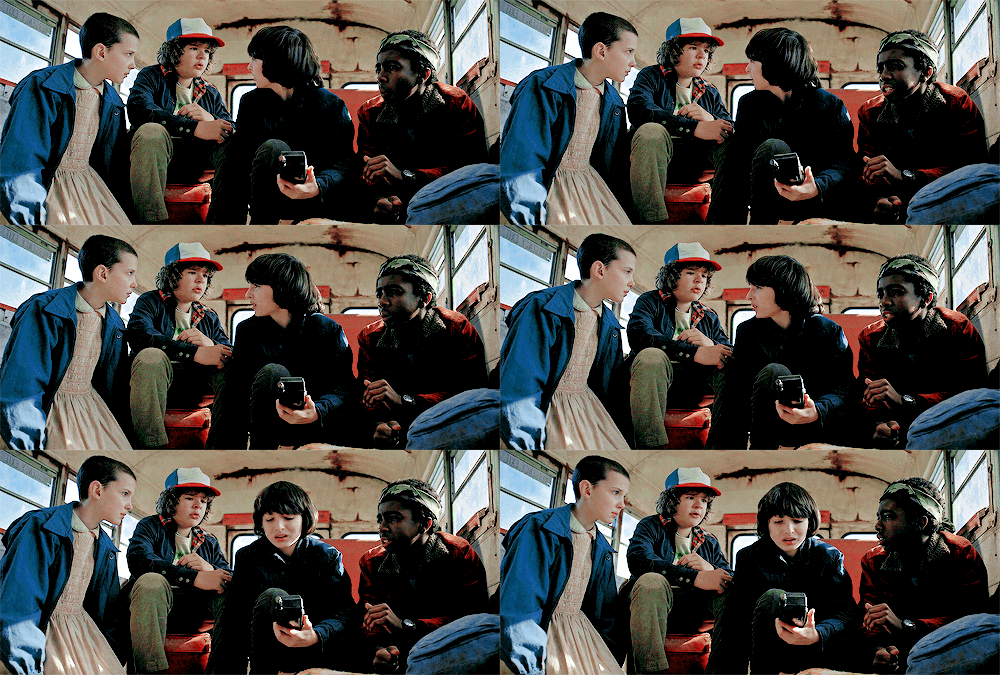
The kids, aside from being great actors, are endearing, funny, and realistic. 


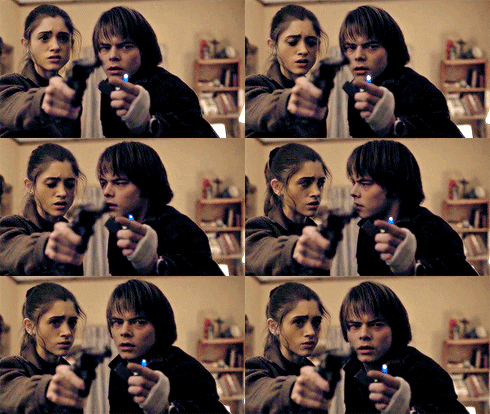
Jonathan is one of those phenomenal characters who is a little bit of an awful person - which, in my opinion, are the best characters. 

I didn't much care for Nancy at the beginning of Season 1, but she really grew on me, and now she's one of my favorites. She's strong and sensitive and unbearably human. 

Also, Jancy is endgame. 

The adults in Stranger Things are competent and compelling and PRESENT. For the most part. 


The characters in Stranger Things are what really sold it for me. Pretty much every character was complex, human, and compelling. If a story has great characters, I'm pretty much down for anything. And for that alone, I love Stranger Things. 


~

And, the moment you've all been waiting for . . . .

The BIG flaw of Stranger Things is . . . . . . 

The Pacing

For a show called Stranger Things, it sure does reveal most of its hand pretty early on. 

I hate to compare it to Lost, but . . . . 

I'm going to compare it to Lost.

So, in Lost, we don't even SEE the Smoke Monster until the end of Season 1, and at that point, it's just snippets. However, the monster is always lurking, giving the other plots throughout the 6 seasons a sense of danger and mystery.

And this is where Stranger Things loses it's footing. There's never that sense of mystery of what all this is. The way the characters figure it out and explain it all kind of makes sense and subsequently makes the remainder of the show seem so much less . . . strange. Sure, there is that thriller/suspense, however, it's undercut by the inclusion of the Upside Down and what the monster actually looks like very early on in the season. 

The show doesn't give its audience time to think over and ponder the mystery. What Lost did so well - and what Stranger Things still has to learn - is finding that sweet spot of revealing just enough to keep the audience guessing, but also not too much that they get bored or can predict what's going to happen. 

Stranger Things would have done well to extend the seasons a bit, and keep some key details under wraps for a longer period of time. 

~

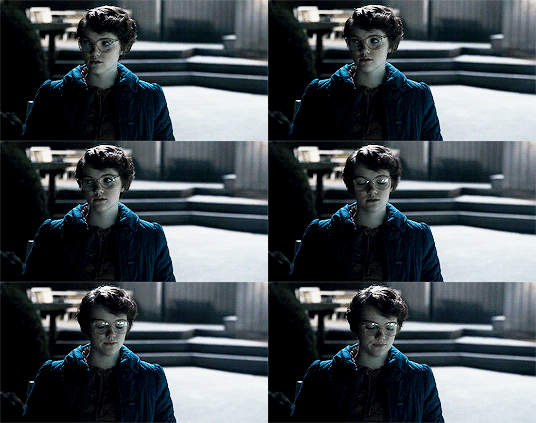
(Also, a little nitpicking: Why does no one else care about Barb? Ahem, she's missing, too.)
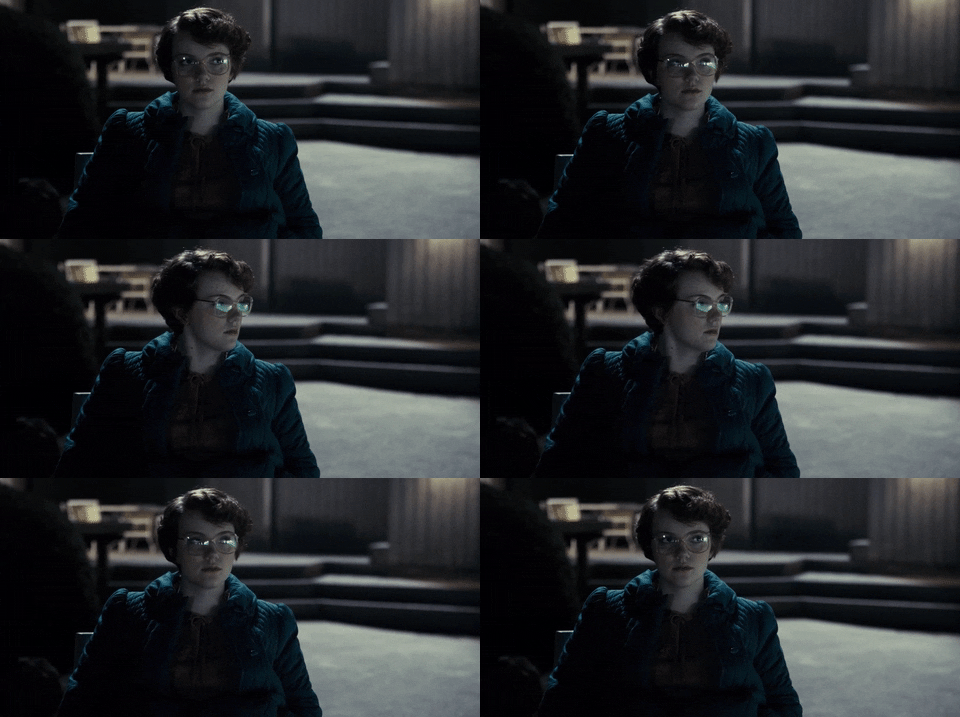


I've started Season 2, and so far, it's better than Season 1, but S1 is still fabulously iconic. 

Please don't rip me apart because I didn't find Stranger Things perfect. 

I mean, I'm not sure that you all expected any different from this self-proclaimed critic. 

~The WordShaker

Saturday, December 9, 2017

Why Repealing Net Neutrality is Fundamentally Wrong

"The art of writing is the art of discovering what you believe," -Gustave Flaubert


To begin, an analogy: 

follow me on Instagram @olivia.j.the.wordshaker

Self-publishing is to traditional publishing, as the internet is to television/blockbuster movies. Self-publishing has revolutionized the book world the same way that the internet has revolutionized communication and video production: with an emphasis on complete and total freedom and creative control. However, the significance of this analogy goes even deeper, with the introduction of the push to repeal Net Neutrality this December 2017. 

What if, suddenly, these printing and indie-publishing companies claimed that you couldn't publish your material if it contained (x, y, and z), assuming (x, y, and z) are completely legal? What if they said you weren't allowed to distribute your book to certain places? What if they started charging you and your customers unnecessary fees, just for their own monetary gain? 

~

There's a lot of things circulating the internet on Net Neutrality, and how the FCC plans to repeal the Obama-era legislation. But I'm not here to talk specifics. I'm not here to talk about whether it's good or bad for the economy or the internet because truthfully, I can't definitively say one way or another. 

What I can talk about is how fundamentally broken the idea of repealing it is. 

Through my understanding, what this Net Neutrality repeal will do is put the control of the internet back in the hands of internet providers (Comcast, AT&T, etc.). This will allow them to promote content they favour, and block others who don't comply with new standards. This will also allow them to add fees and payments to users who want to access certain sites. 

Of course, much of this is speculation, and truly we don't know how things will turn out, or if things will even change all that much for the little guys. 

But again, I'm here to talk about the big ideas behind this debate. 

The problem is that the internet has already established itself as a free and open platform for anyone, big and small, to share most anything. And by implementing these changes, it directly subverts what the internet is based on: creative expression, and freedom of thought. 

Part of the changes that repealing Net Neutrality will set into motion is the control of access to websites. If the government knowingly allows internet providers to 'censor' content - despite whether it is a moral 'censoring' or not - then the government is indirectly infringing upon our rights to freedom of speech and expression. 

Another point is that the man who set this repeal into motion, Ajit Pai of the Trump administration, claims that this will positively benefit the free market, by putting the control in the hands of the internet providers and not in the government, because, in fact, these internet providers are private companies. 

However, this is backward thinking, because, as previously established, this will make the internet a less fair and neutral place, which is not what it should be. When you have such a massive, global, and universal platform like the internet, it's hard for it to still fit in the box of 'private companies', despite technicalities. These companies will attempt to liken the internet to cable tv, which entirely undermines the purpose of the internet to begin with. 

Assuming the internet will no longer be a free and open platform, the internet will suffer because of the control these internet providers will have to censor media. The internet will likely change, most likely for the worse. Ensuring the freedom of media through the internet is just as important as ensuring the freedom of the press, even if it isn't explicitly outlined in the Bill of Rights.  

Don't get me wrong: this isn't directly a First Amendment issue. The 1st Amendment states that "Congress shall make no law...", and technically Congress isn't making any laws. 

However, it is more of an issue of morality: What does this change mean for freedom on the internet? How do we define the internet and it's role? Does this infringe on not the legal, but the moral rights of the people to access what they please on the internet with no hoops to jump through? 

Maybe this is idealistic thinking, but I went into this blog post establishing that we weren't going to be talking facts, but ideas. I'm not entirely sure if any of my arguments are supported or make any sense, but I want to get a dialogue going. Comment your thoughts down below! 

Truthfully, I am morally opposed to the idea of repealing Net Neutrality based on the information I've found. Keeping Net Neutrality is essential for keeping the internet a viable and creative tool for freedom of expression, media, and thought. 

Call your Senators, send letters, sign petitions, check out BattleForTheNet.com, and exercise your First Amendment right to protest and petition the government. 

In case you can't tell, I love and feel very strongly about the First Amendment. If I get a tattoo, it will probably be those 45 words. 

~The WordShaker

Saturday, December 2, 2017

Develop a Character in 250 Words - 3 Tips

"The desire to write grows with writing," -Desiderius Erasmus

Yes, you heard me right. In less than 250 words, you can give your reader a full and well-rounded view of your character within the first page. And, if you're writing a short story or flash fiction, this is the blog post for you!  

Now, you ask, cramming in as much information about your character into such little space must be bad writing, Olivia

And, to that little voice in your head protesting that this isn't a good technique, I say that we're not cramming any information anywhere.  I think we can all agree that writing a massive paragraph on what your character's personality is is a bad way to introduce a character. 

All things considering, here are 3 tips on how to SHOW who your character is in less than 250 words:

1. Go Big or Go Home

A key to showing the reader the major parts of your character's personality is having said character in action. This action usually has to be something extreme or dramatic. Through introducing your character during this large event, the reader is able to see how your character reacts to the world.

For example, the two main characters in my novel, A Cactus In the Valley are introduced in medias res. Terra is introduced while she is still inside of the plane wreckage, and the first chapter is her trying to get out. Through this immediate conflict, we are shown how Terra reacts to barriers to success, strong emotions, and trauma - all integral parts of her character.

By having your character start off in an extreme situation, the reader will immediately know the larger parts of the character's psyche. 

You can use this by dropping your character right in the middle of a space battle, have your character go to a party where the police show up, or even something as small as having your character fall right on their face in public. 

2. Italicize

This doesn't necessarily mean that you have to italicize your character's thoughts all the time. What I mean is that the second key to introducing a character quickly is through their inner monologue, their voice, and their thoughts and opinions to the world around them. 

By giving your character a unique and distinct voice, the reader will get to know the character's opinions and personality traits within a few lines. 

In the second chapter of A Cactus In the Valley, parts of Wyatt's character are revealed through his thoughts and personal comments on what is happening in the story. These sentences show how Wyatt feels about Terra, his general attitude, and his sense of humor.  

Through these small lines of thoughts, the lighter parts of the character's personality take center stage. 

You can implement this by figuring out your character's personality, and then inserting the snide comments they'd make, adding in references to their past, or hinting at a deeper internal conflict. 

3. Wrap it in Foil

Foil characters are one of the easiest ways to develop a character. A foil character is a character that acts as a 'foil' to another character. One character's traits contrast the other character's traits. 

This tactic develops characters in that the foil characters make each other more distinct, and make the other stand out. Like salt and sugar, the two characters contrast each other: one is bitter, the other is bubbly; one is snarky, the other is tight-laced; etc. 

Wyatt and Terra from A Cactus In the Valley are foil characters to each other. From even their first interactions, the reader is able to see that the two display distinctly different personalities through dialogue. 

You can use this technique by introducing your character speaking to their foil, forcing two foil characters to interact, or arising conflict from said foil characters. 

~

By using these three tips, you can develop a character with lightning speed and precision. In one scene, you can show the character's defining attributes, get inside of their head and show their personality, and show how they interact with other foil characters. 

These tips can be used in anything from a 150,000-word novel to  250-word flash fiction. And I hope at least one of them helped you out. 

~The WordShaker

Saturday, November 25, 2017

X V I I I ~ Olivia J

"Creativity is an act of defiance," -Twyla Tharp

When I was a kid, I never thought about what I would be like when I was 18. 

I'd always imagine becoming a teenager at 13, my sweet 16, and then that elusive period of being an adult, of when I was past college age and all on my own. 

But never 18. 

Of course, being 18 doesn't feel any different. I never feel any older until a crisis sets in mid-December or January, and I have to start telling people my new age. 

Regardless, I never thought I'd be here. I never thought I'd have some of the best friends in the world still by my side.


I never thought I'd be a published author. I never thought I'd be going to the college of my dreams. I never thought there'd be almost one thousand of you on my Instagram. 


I never thought my life would be this way because I never thought about this strange, in-between stage. The stage where slowly, the ideals and characteristics of being young are stripped away. The stage when bricks upon bricks of responsibility are piled upon your back, and you finally realize how heavy it all is. 

But what's really gotten to me is how very little time I have left in the Breadbasket of America. It hit me at 2am on the night of my 18th birthday. It hit me on the last night of the musical. It hit me when Mom and I were making food in preparation for Thanksgiving. It hits me every time I drive past my old job, past my high school, past the woods that Andrew and I have turned into Narnia. 

Yet, I dream of my life in college. I dream of the freedom, the fertile, creative ground I'll be seeded into. I dream of my future, and the great and terrible adventure that stares me down. 

So, to everyone: I already miss you. But 18 presents insurmountable challenges that I have no choice but to face.

All glory be to Christ, to whom I owe everything. 

~The WordShaker

Saturday, November 18, 2017

HOLIDAY DISCOUNT: A Cactus In the Valley for Christmas


It isn't what you write, it's the way you write it," -Jack Kerouac

Cold weather got you down? In need of a warm, pick-me-up?

A Cactus In the Valley is just the story for you! Set in a scorching desert environment, my novel is the perfect Christmas gift for you or your teen. 

From now until January 8th, you can buy my novel for just $10! 


Unfortunately, the price will remain the same on Amazon - but if you buy it from me in person, you'll get a whole 40% off!

Message me on any of my social medias to meet up, or see me at school, and you can get my book for just $10!

Thank you to everyone who has supported me on this journey, even if you're not a reader.  You're one of the reasons I'm chasing my dreams. 

~The WordShaker

Saturday, November 11, 2017

This isn't a real blog post. | Olivia J

"A professional writer is an amateur who didn't quit," -Richard Bach 

7:55pm. Haven't written a blog post yet. 

Cutting all of the saccharine junk, I'm at a blogger's block. Is that a thing? Regardless, I've barely been able to focus on my novel writing, much less crank out quality blog posts. 

Which is why this isn't a blog post. 

Well, maybe not a quality one. 

In order to fill the space - and to trick you all into thinking that this is a legitimate blog post -  I'll be sharing some of the things that might make it onto above-the-fold headlines if my life was a newspaper. 

Which, unfortunately, it's not. 


TEEN AUTHOR CAN'T STOP COMPARING HERSELF TO OTHERS - CHAOS ENSUES


AP ART STUDENT WANTS TO GIVE UP, BUT SUPERSTAR GRANDPA WON'T LET HER

MERSISTER DONS BLUE WIG: WANTS TO CHANGE NAME AND MOVE TO CANADA

BREAKING! DOCTORS DISCOVER THAT TEA IS THE ULTIMATE CURE-ALL


Ok, but in all seriousness, I've pretty much been having a crisis ever since my book was released. My life has been a slew of comparing myself to other teen authors, not feeling good enough, creating, deleting, and recreating. And among an endless cycle of things I have to do. 

But above all, I can't wait to get to Atlanta and do whatever the hell I want. 

~The WordShaker

Saturday, November 4, 2017

Forsaken by Brittney Kristina | BOOK REVIEW by Olivia J

"As a writer, you try to listen to what others are saying . . . and then write about the silence," - N. R. Hart

Long time, no see! I haven't done solely a book review in a while, mostly because I haven't had all that much to say about the books I've read lately. But this week's post features a fellow teen author, Brittney Kristina. 


follow her on Instagram @brittneykristinabooks

As with most of the books I read, Forsaken falls into the middle ground of some negatives and some positives. 

The Negatives

1. The Writing

Albeit not bad, Kristina's writing is lackluster. The sentence structure has little variation, and the style reflects an 'and then' pattern. While this doesn't indicate a poor writer, I prefer the medium in which the story is being presented to me to be poignant, effective, and descriptive. Kristina also relies on adverbs a lot, which clutters the prose. 

My other problem with the writing is that it fails to invoke emotion from the reader. Because of the aforementioned pitfalls in the writing, the moments that should be heartbreaking and tender fall flat, and the moments fueled with anger come off as irrational. 

2. The Length

This is a big one. Forsaken, reading at 266 pages, feels more like a third draft than a finished novel. This is because of several factors. 

The first is underdeveloped characters. Skylar Vail, although a fine character herself, falls prey to crying all the time. Although sure, these are times worthy of tears, but crying should be used tactfully because it can easily turn an emotional character into a crybaby. Tristan serves not much more purpose than to be eye-candy, which Skylar frequently reminds us of. 

The supporting cast, primarily the characters in the mental hospital, are outlines of characters. I frequently forgot who they all were and what their defining character trait was. The only character who mattered all that much to the story was Annabeth (a.k.a. Onyx). 

With more refinement, Skylar could reach Katniss Everdeen levels of awesome. With more time, Tristan could become a deeply complex, broken character. With more time, all of the supporting characters could become snippets of three-dimensional people. 

Some of my favorite characters were Mrs. Carter, Andria, and Onyx. Mrs. Carter seemed the most complex, and I enjoyed her relationship with Skylar. Andria and Skylar did have an interesting relationship, and Onyx was a badass, even though she softened to Skylar way too quickly.  

The second is the development of themes.

There are almost infinite ways to develop a theme in a story, through a character's actions, development, and change in a story, through symbols, contrasting values, parallels, allegories - the list goes on. 

However, Kristina only uses one or two of these tactics to develop her themes of love, brokenness, and healing. Occasionally, she'll use a situation or a setting to develop the theme, but more commonly, it's explained through two characters talking, or Skylar musing to herself. 

The problem with relying heavily on dialogue-driven themes is that they quickly become contrived and heavy-handed. Instead of letting the audience figure out the theme based on situations, character arcs, comparisons, and symbols, Kristina ops for just having a character say it, which is obviously less effective if you want the theme and message to truly stick with the reader.

Conclusively, 100 more pages of development of characters, setting, and themes would make Forsaken a much more complex and interesting read.

3. The Setting

Mild spoilers ahead. The 'dream' plot is set in a fantasy world where it seems that Skylar and Tristan are the only two people in said world. The message is that Skylar and Tristan are broken, but different and that love is powerful and multi-dimensional (literally). 

However, when you work in a setting like this, where everything means something, the author should make it clear that everything mentioned is important. When presenting fantasy elements like telepathic animals, pale zombies, and a Romanesque society, all of these should add up to reflect something in our world. Some elements were made clear, such as the whale scene, which was most likely an allusion to the Biblical story of Jonah, however, others that were left unexplained and ignored made the world seem underdeveloped and less fleshed-out. 

To combat, a retort to what I've just said would be the common 'maybe you just didn't understand the themes'. And hey, maybe I didn't. Maybe they went right over my head. But to that I say: it shouldn't take someone with a doctorate in English Language Literature to understand the importance of your setting.


And, because I like to end on a positive note:

The Positives

1. The Structure

The unique structure of this book is truly what sells this story. It's told through flashbacks that don't really feel like flashbacks, and they're actually quite effective in explaining the narrative and the characters. The time in the 'dream world' is almost evenly split with time in the mental hospital as well as real-world flashbacks, and this creates a balanced feel to the story. It's something new and creative, and I commend Kristina for this structure.

The structure also adds to the suspense and the mystery woven throughout. The cliffhangers and endings left me racing through the next chapters and add to the atmosphere of the novel. I could see this being a TV show, and I'd like to see more stories with unique structures like Forsaken

2. Enjoyment

Despite all of the things I've complained about in this review, I did enjoy reading this book. The twists, the betrayals, and the cliffhangers were impactful and flowed well. Forsaken was never predictable, and it kept me hooked. I genuinely did want to finish this book, and I dedicated a lot of the last 3 days reading Forsaken

In literature's most elementary state, its purpose is to entertain. And that's something this novel did very well.

3. That Strange, Self-Published Charm

This one's a bit harder to explain, but I've found it throughout all self-published books I've read. It's this passionate, home-grown charm.

Think of it like this: When buying an apple from the grocery store. It's firm, symmetrical, and a glossy red. Sweet and predictable. Tastes like an apple, sure. 

Let's say you pick an apple from a local orchard. It's textured, has stripes of yellow, red, and green, and a little misshapen. But it's an apple. And it tastes tart and earthy, like the tree was pruned with love and the soil was nurtured. 

Both in the aforementioned fruits are apples, but one is engineered for perfection and polished bare. The other is flawed and imperfect but full of flavor. 

It's like this with books published by major publishing houses, and self- or indie-published books. Albeit not bad, books from major publishing houses are written, edited, and marketed to fit the publishing industry's mold, sometimes at the cost of genuine and creative innovation. 

However, self- and indie-published books are outside of the market, and they have the ability to be imperfect but also to be avant-garde and filled with passion. Forsaken has this quality to it, and all self-published books with this feel are a breath of fresh air to the literary world. 


Overall, there is a fantastic book buried within Brittney Kristina's Forsaken. However, 100 more pages of development would refine this story into something phenomenal. 

6.5/10 would recommend.


~

Man, I forgot how much I love writing book reviews. I should do this more often. 

~The WordShaker