Showing posts with label review. Show all posts

Saturday, August 25, 2018

Book Review: 'Saving Ivy' by Emily Reilly | Olivia J

"Most writers regard the truth as their most valuable possession, and therefore are most economical in its use,"
-Mark Twain

It's strange, but I think I read indie author books faster sometimes. Or maybe it's because this one was a contemporary. 

But alas, this is yet another indie book review! I don't think I'll ever get tired of reading work from my peers.


Disclaimer: I received this book in exchange for an honest review. Thank you so much Emily, you should totally follow her on Instagram @emreilly!

Spoilers, duh. 

TW: Saving Ivy deals with heavy topics, including but not limited to: self-harm, abuse, rape, violence, and suicide. You need to go into this book with the right mindset. If you have suicidal tendencies, DO NOT read this book. 

The Bad

1. The Writing

This has two main points, so I shall break it up for ease. 

      a. Thoughts In Italics

Reilly's writing heavily employs a tactic where the literal thoughts that run through a character's head are included in the prose and then italicized. 

When used sparingly, they can be very effective. However, instead of using word choice, syntax, or dialogue to convey thoughts and emotions, Reilly relies on clipped words or phrases to express what the character is thinking or feeling. The overuse of it quickly begins to feel juvenile, and borders on telling instead of showing. 

      b. Development of Different POVs

Saving Ivy has at least four different point-of-views, but the story is mostly told through Ivy, Aunt Wiley, and Joseph's point of view.

As someone who mostly writes in first person dual or multiple perspective POVs, I feel that I can come from a place of experience and offer some critique but also advice. I've been writing with multiple perspectives since 2013 - that doesn't make me an expert by any means, but it does mean that I know what I'm talking about to some extent. 

The trick with writing multiple perspectives is voice. I mean, you as a writer and also the POV character should have their own distinct voice even if you're writing one POV. 

However, it's even more important that you develop strong character voices in a story with more than one POV characters. It just makes sense from a literal perspective: all humans think differently. We all use different syntax, we have different levels of vocabulary; what we say and how we say it varies greatly from person to person. 

In order to develop this, you have to consider so many things about the character: How old are they? What is their education level? What is their sense of humor like? What is their outlook on life? What region or part of the world are they from? All of these things influence a character's voice. 

The unfortunate problem is that Saving Ivy doesn't develop its POV character's voices. The writing style is virtually the same across Ivy, Aunt Wiley, and Joseph (although Joseph's voice is the most developed, I will give credit there).

The different POVs aren't confusing because you're not sure who's speaking - because the reader can deduce that from the content - they're confusing because everyone sounds so similar. It makes the writing flat and less engaging, as well as not allowing us to fully get into the POV character's head. Part of immersing the reader in the character is being able to see how that character thinks, perceives, and feels. Saving Ivy severely lacked the proper development of the three POVs in order to make them distinct and engaging. 

2. Lack of Complexity

Stories - and their levels of complexity - change in order to fit the target audience. Middle-grade books have more character depth, plot development, and tackle deeper issues than simple chapter books. Young Adult books take everything from MG and dig even deeper, and tailor the subject matter to fit the audience. Adult fiction is often the deepest and most complex of all fiction, mostly because adults are fully developed and can comprehend all of the subtlety, nuance, and complexity contained in adult fiction. Sure, there's some overlap, but as a general rule, there are specific ranges and levels for how complex an age-range of stories is. 

However, despite the content, Saving Ivy reads more like a middle-grade novel in terms of development and complexity. What makes YA so subversive is that it has the capability to be as complex as some adult fiction, while still catering to a younger demographic. What I mean by complexity is the ability to portray many different things in the context of one story, and the ability to interweave and connect multiple story threads while furthering the character arcs and plot. 

In Saving Ivy, there's not much going on. There's kind of just this one plotline of the interactions between Joseph, Wiley, and Ivy - and a few other small things thrown in. I feel like this has to do with the length of the book. Everything is kind of right on the surface. There's not much subtext, and the entirety of the plot, themes, and character development is right there in front of you. The story doesn't have many levels - each scene furthers one aspect of the plot. With some more character arcs and subplots thrown in, Saving Ivy would have had much more development and complexity. 


The Good

1. The Flashbacks (& some of the writing)

I'm a sucker for some good flashbacks - *cough* A Cactus In the Valley *cough* Lost. And the flashbacks in Saving Ivy were done so well and added so much to the story and the characters. They were short, but packed such an impactful and significant punch. It was like looking through a keyhole, but still able to see all that you needed without the flashbacks interrupting the story or dragging it down. There was more implied backstory, and I feel that this worked in favor of the narrative to balance out some of the heavier subject matter and depressing tone of the book. Reilly could have easily packed in the long sob-backstories, but she chose to make them short and sweet (in the colloquial sense of the last word). 

Now, based on the critiques I've made of Reilly's writing, it would be safe to assume that I think that Reilly is not a good writer. However, that couldn't be further from the truth. There were some passages and some lines in Saving Ivy that took my breath away, that forced me to reconsider things, and absolutely pulled me in with the unique descriptions. Reilly's moments of literary brilliance deserve just as much recognition. 

2.  Portrayal of Mental Illness

Now, before you all come at me with your pitchforks about last week's blog post, hear me out. I came into this book with the right expectations, and that greatly influenced my enjoyment and reception of Saving Ivy

Saving Ivy is not a happy book. It's very depressing, and I think it's important that you go into this book with that mindset. I suppose the title of 'Saving' Ivy is misleading, but that's neither here nor there. 

However, what Saving Ivy does right is that it shows how mental illness and strong emotions can warp someone's sense of reality and their ability to think clearly. That's why it's mental illness. So no, I don't berate or criticize Reilly for portraying Ivy's suicide as 'saving' her or as her finally finding peace, because for many people, they are deluded to believe that suicide is their only way out. They truly do believe that suicide will stop their pain. 

Reilly successfully portrayed the mind of a suicidal person, and how that kind of thinking can warp one's perception. I think that if you go into this book with the right mindset, and with this in mind, the suicide, as well as all of the other mental health topics discussed in the book, will not seem like a cop-out or as a harmful portrayal. 

Saving Ivy can be compared to works like Manchester by the Sea or Les Miserables - although these words are mammoths in comparison to Saving Ivy, they all are super depressing with somewhat hollow endings. And I feel that we need stories like this to balance out the tendency for all stories to end happily, or, rather, for all stories to have their conflicts tied up in a pretty bow. Because life doesn't work like that - sometimes bad things happen over and over and over and sometimes people die and sometimes conflicts never get resolved. I greatly commend Reilly for tackling this concept. 

~

Final Thoughts: While fundamentally flawed at points, Saving Ivy shows Reilly's literary prowess through her use of flashbacks and tackling of deeply emotional and less discussed topics. What holds the novel back are its lack of strong POV voices. Despite this, I enjoy the genre and subject matter of Saving Ivy, so for that I thoroughly enjoyed my time reading Reilly's work.  

Objective Rating: 6.5/10
Enjoyment Level: 7/10


~The WordShaker

Saturday, January 27, 2018

How I Review Books | Olivia J

"We read to know we are not alone," -William Nicholson 

Now, this is a strange one, because I feel like, to the moderate reader, rating books is simple: one-through-five stars. However, I review books very differently than other people. I say this because, to me, a 2.5 star book isn't a bad book. Just an average one. 


~

First, I think it's important to understand how I read. 

I read - and watch - VERY critically. I try to be both objective and subjective when I read or watch anything. The objective side of me analyzes the writing style, the character development, the story structure, and the overall effectiveness of these elements. The subjective side of me considers how much I like the story, how much I love the characters, and my overall enjoyment of the work. 

Now, these two things do intersect a tad. I tend to enjoy a book more if it's well written and constructed. I certainly have preferences that effect both my subjective and objective reception of a book. 

~

Onto how I rate books, specifically. On my blog, it's a little different than how I rate books on Amazon/Goodreads. 

On my blog, I use two different rating scales. The first is my 'Objective Rating'. With my Objective Rating, I evaluate the book on technical levels. Does the writing flow, and does it fit within the story and character context? What events and elements add or detract from furthering the story's plot? How are the characters developed, and why is it effective or not? , et cetera. 

Strangely enough, there is a small gray area that contains books that are objectively good, but that I didn't enjoy. For example, I thought Charlotte from Retribution Rails was a well written character, but I just didn't like her all that much. Looking back, I think Frankenstein is a brilliant exploration of the ethics of science, groundbreaking science fiction, and the state of monstrosity, but I absolutely hated my life every time I had to read it. Books, and elements from stories sit in this small gray area, where the said work is technically good, but it just didn't connect with me personally, so I didn't enjoy it. 

Secondly, the other way that I rate books is on my 'Enjoyment Level'. This one's pretty self explanatory. For this category, I consider my personal preferences, the entertainment value, how engaged and invested I am, and of course, how much I enjoy the overall reading experience. 

Some books (and stories) that I think are objectively not very good, but I still enjoyed them include the tv show Riverdale, and the ACOTAR series by Sarah J. Maas. The ACOTAR series is problematic and cluttered and corny, but the first two books sure did hold my interest and provided more than enough smutty entertainment. 

I rate both of these scales on a zero to ten scale (although I've never rated anything a zero before). This influences my overall out-of-ten score, which I frame as "X out of 10 would recommend." I usually omit how I rate the book on Amazon/Goodreads, since that kind of undercuts my previous three ratings in the first place. 


~

In conclusion, when I rate a book 2.5 out of 5 stars, it doesn't mean that I didn't like the book, despite what the rating looks like aesthetically. Truly, it means the book was average. However, I do save 5 star ratings for books that blew me away. 

I hope this helped you better understand how I rate and review books! What's your process for reviewing something? Let me know in the comments of this post or on Instagram @olivia.j.the.wordshaker!

~The WordShaker


Saturday, December 16, 2017

The ONE Flaw in Stranger Things S1 | Review by Olivia J

"I think we ought to read only the kind of books that wound and stab us," -Franz Kafka

I love Stranger Things

Yes, you read the title correctly. I do love Stranger Things


Follow me on Instagram. I post fun stuff.
However, like most things, it's not perfect, despite what everyone and their mother says. 


For this review, I'm not going to go in depth on why Stranger Things is fantastic. There are hundreds of other reviews for that. Mostly, I'm going to discuss the one flaw that holds it back from greatness. 

(Spoilers, duh.)


Everything else (music, cinematography, atmosphere, etc.) was all really good, but I will mention the major thing that resonated with me.

The Characters

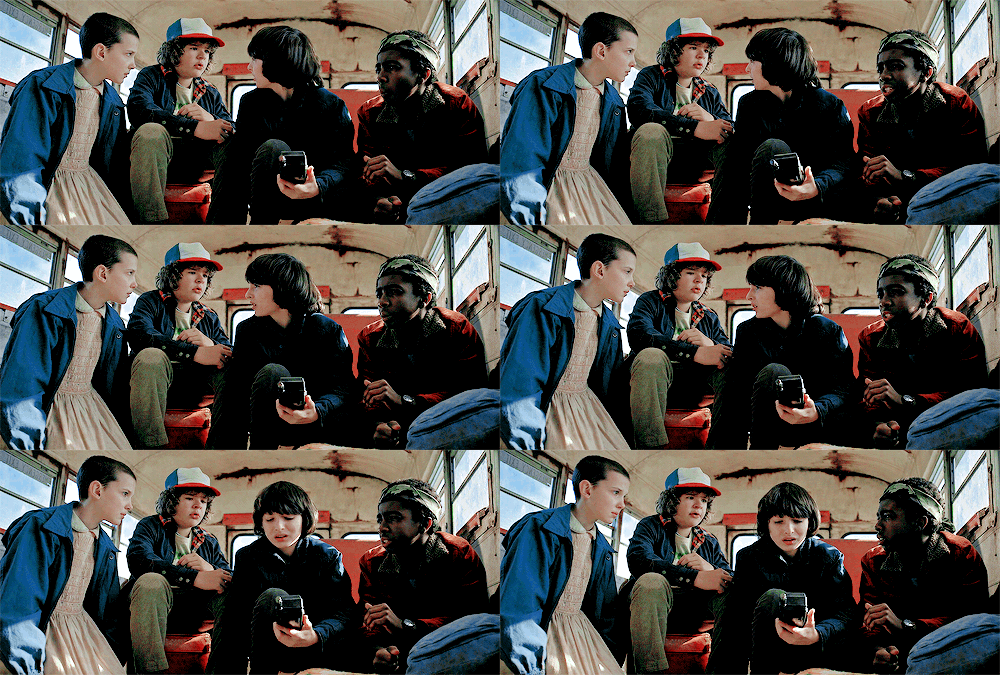
The kids, aside from being great actors, are endearing, funny, and realistic. 


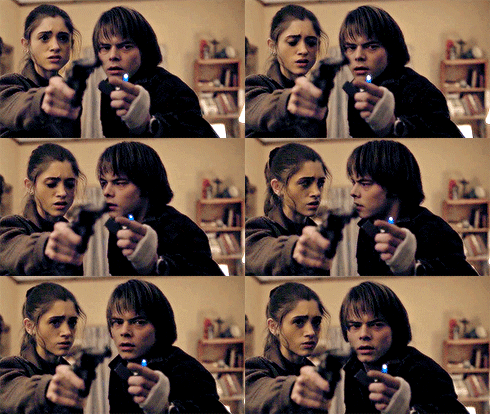
Jonathan is one of those phenomenal characters who is a little bit of an awful person - which, in my opinion, are the best characters. 

I didn't much care for Nancy at the beginning of Season 1, but she really grew on me, and now she's one of my favorites. She's strong and sensitive and unbearably human. 

Also, Jancy is endgame. 


The adults in Stranger Things are competent and compelling and PRESENT. For the most part. 


The characters in Stranger Things are what really sold it for me. Pretty much every character was complex, human, and compelling. If a story has great characters, I'm pretty much down for anything. And for that alone, I love Stranger Things. 


~

And, the moment you've all been waiting for . . . .

The BIG flaw of Stranger Things is . . . . . . 

The Pacing

For a show called Stranger Things, it sure does reveal most of its hand pretty early on. 

I hate to compare it to Lost, but . . . . 

I'm going to compare it to Lost.

So, in Lost, we don't even SEE the Smoke Monster until the end of Season 1, and at that point, it's just snippets. However, the monster is always lurking, giving the other plots throughout the 6 seasons a sense of danger and mystery.

And this is where Stranger Things loses it's footing. There's never that sense of mystery of what all this is. The way the characters figure it out and explain it all kind of makes sense and subsequently makes the remainder of the show seem so much less . . . strange. Sure, there is that thriller/suspense, however, it's undercut by the inclusion of the Upside Down and what the monster actually looks like very early on in the season. 

The show doesn't give its audience time to think over and ponder the mystery. What Lost did so well - and what Stranger Things still has to learn - is finding that sweet spot of revealing just enough to keep the audience guessing, but also not too much that they get bored or can predict what's going to happen. 

Stranger Things would have done well to extend the seasons a bit, and keep some key details under wraps for a longer period of time. 

~

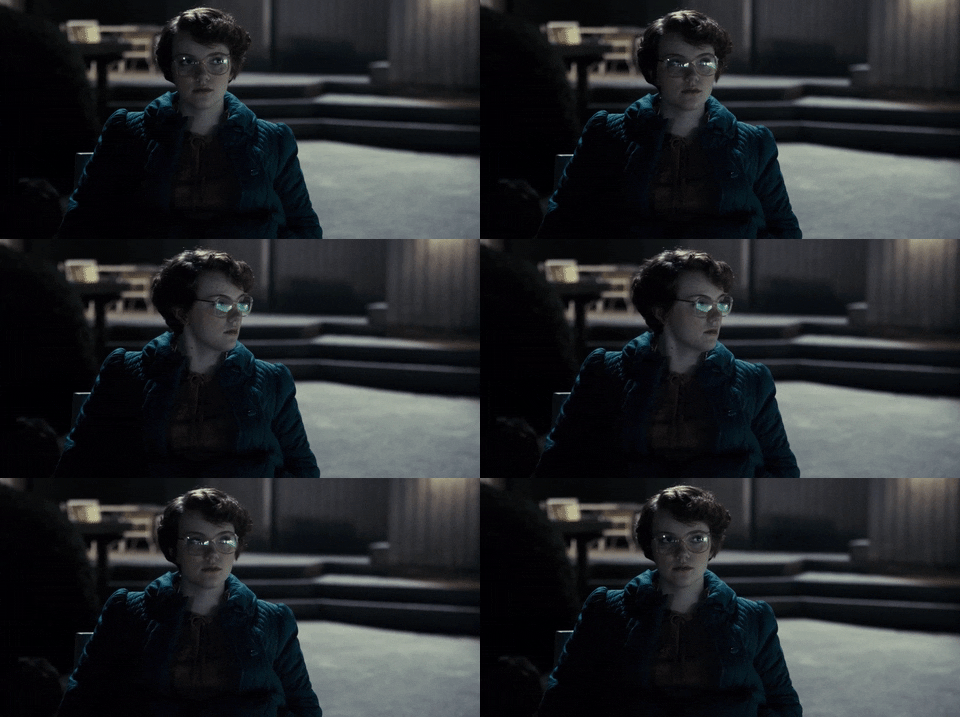
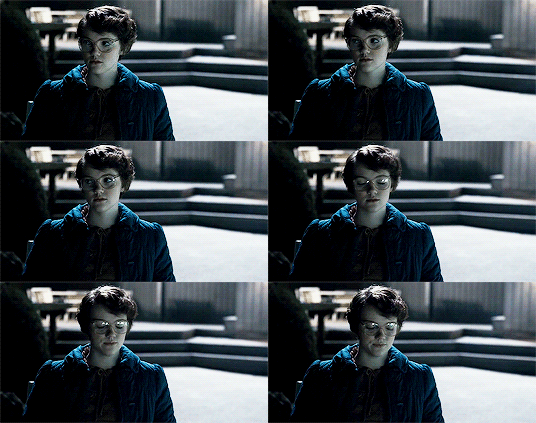
(Also, a little nitpicking: Why does no one else care about Barb? Ahem, she's missing, too.)


I've started Season 2, and so far, it's better than Season 1, but S1 is still fabulously iconic. 

Please don't rip me apart because I didn't find Stranger Things perfect. 

I mean, I'm not sure that you all expected any different from this self-proclaimed critic. 

~The WordShaker

Saturday, September 23, 2017

The Missing Song from The Hunchback of Notre Dame

"Drop the word 'aspiring'. Write. Then, write some more," -Joanne Harris

Don't get me wrong, I loved The Hunchback of Notre Dame. 95% of it, at least. 

Recently, I viewed Hunchback when our local theater put it on, and since my best friend was in it, I had to see it. Even though Lauren pretty much told me the whole plot and I had sampled some of the soundtrack with her while driving, I was mostly unfamiliar with the show to begin with. 

However, I loved it. Both the performances and the source material. The actor playing Frollo disappeared into his character was a full bass, and the actor playing Quasimodo was absolutely charismatic, and had a voice like butter on hot toast. No one else in particular blew me away, but the cast was solid despite any weak links. The set was exquisite and the atmosphere/staging added a lot to the show. 

The source material is a whole nother beast. On one hand, songs like "Out There" and "God Help the Outcasts" are spine-tingling and moving, and the musical motifs tie the musical together.

But on the other, it's lacking a climax. Sure, you could pinpoint the 'climax' on a story arc, but it's missing the intensity and the emotional power that a climax should have. 

The problem about the last song, specifically when Quasimodo has just killed Frollo, and he brings Esmeralda's body up front, is just that. There's no true last song. 

Hunchback is lacking a final number of just Quasimodo. Throughout the whole show, it is shown to be a character trait of Quasimodo that he expresses himself through powerful song - see "Out There" and "Made of Stone" - and the end almost feels out of character for him because of that. One could argue that he was too sad to sing because everyone he ever loved was dead, and to that I say, his emotions should have been more clearly shown through the music and Quasimodo's acting, which it wasn't. 

We, the audience, have come through this musical deeply caring about Quasimodo, and, as this show is an almost Greek-like tragedy, the audience also deserves that deep look into Quasimodo, that catharsis that makes tragedies so universal and great. The audience wanted - and deserved - to see Quasimodo go through the stages of grief in a heart-ripping song, and to also explain why he wasn't able to move on. Without the last long depicting how Quasimodo has changed and the depth of his grief, the ending doesn't feel final, unlike what the whole show was building up to. 

Hunchback needed that final Quasimodo solo, of the finality of the show and for the finality of Quasimodo as a character. The audience shouldn't have to infer this much on the thoughts and emotions of a character - the job of the writers and musicians and actors is to make the audience feel them, and this is one of the few places Hunchback fell flat. 

Overall, I liked it, and actually loved it. But you all know me, I get off on analysis, so try and enjoy it anyway. 

~The WordShaker

Saturday, January 28, 2017

Success as a Writer | Olivia J

"Writing is a dangerous profession. There's no telling what hole you may rip in society's carefully woven master narrative," -Danielle Orner

Recently, I've revived some of my wonderful beta readers. Yesterday, one of them finally finished my novel, way ahead of time.

One of her comments at the end of the last chapter was:

"Honestly, it's been a while since I got emotionally invested in a story like I did with this one. You are a brilliant writer, and I'm so excited to see where you go with this beautiful work of art. When you're a famous author someday, I will have the privilege of being one of your biggest fans. This story was so powerful and full of messages that aren't easy to read, but need to be shared. Thank you for pouring your heart and soul into this book. I am confident it and all of your writing  will go on to inspire people for generations to come."

This comment almost made me cry. Nothing - and I mean nothing. No paycheck, no award, nothing - can compare to the feeling that your reader got it. They fully understood what you were trying to convey, and it impacted them.

This is true success as a writer. Many people think when I say I want to be an author, they think I want to be the next Stephen King or J.K. Rowling. And truthfully, it would be nice, but the fame and the money isn't what it's all about. 

And sure, being a household name means more people will buy and read your books, which will make the story have a larger impact in numbers, but true success as a writer isn't determined by the number of copies you sell, or how much money you make. 

It's determined by the souls you touch and the lives you change. This cannot be quantifiably measured, by any statistic, any paycheck. It's the impact you make on others, and yourself, that matters. 

Now, writers, go get people to read your work - because the most satisfying thing is knowing your art -the very thing that helped you heal your heart and soul - reached across the great human divide and healed someone else's. 

~The WordShaker

Saturday, January 21, 2017

Netflix's A Series of Unfortunate Events TV Show Review

"Take your broken heart, and turn it into art," -Carrie Fisher

When I heard that Netflix was creating a TV Show version of one of my childhood favorite book series:  A Series of Unfortunate Events. These books connected me and my friends in fifth and sixth grade, especially with my soul sister, Lauren. The series absolutely enraptured me with progressive and quirky characters, the absolute nail-biting terror of Count Olaf, and the weaving mystery throughout all 13 books. It reached the darker, mature parts of me, and unlocked them. And I absolutely loved it - it was a good thing for me. It was one of the books that shaped me into the writer, reader, and consumer of stories that I am. 

Last Sunday, two days after the series came out, Lauren and I binge-watched it, complete with leftover Asian food and mug cakes.

follow me on snapchat @hootowltree

As usual, I conduct my reviews by talking about the negative first, and end with the positive. 

The Negatives

1. Violet

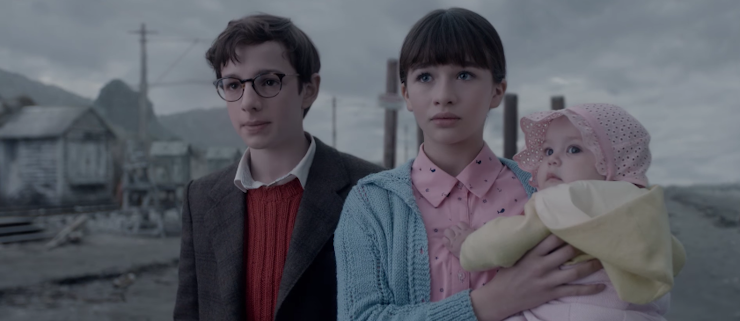
When I first read the books, I adored Violet. As the eldest, as a massively creative person who loved working with her hands, as a subtle and assertive girl myself, I deeply related to Violet. And when on-screen Violet was short, girly, immature, without much agency, and not at all the tall, strong and inventive girl portrayed in the books. 

This partially has to do with Malina Weissman chewing on the scenery. Something Lauren wisely pointed out was that Weissman possibly had the idea in her head that this was a children's TV show and that children would be watching it, and so she should act (or, more correctly, overact) to reach to the simplicity of the 'children' watching the show. 

This also has to do with the age difference - or lack thereof between Violet and Klaus. Violet is supposed to be 14, and Klaus 12. In the illustrations, the height difference between the two is drastic. However, in the tv show, the two are relatively the same height. 


This adds to Violet feeling less like the leader, and less mature than she should be. Weissman looked and acted to young to be the Violet she should have been. I tried, I wanted so badly to like Violet - at first, Lauren agreed with me - but I couldn't, because she never filled the shoes of the fantastically creative, somber, and mature Violet. 

The Neutrals

1. Count Olaf

Visually, Neil Patrick Harris was perfect. However, it took me a while to be sold on his portrayal of Count Olaf. At first, he seemed too comical and inflated to be the menacing Count Olaf. There were touches of it, however, throughout the first season. But what sold it for me was when Olaf outright slapped Klaus, and his reaction, and the lasting effects this has. It was a truly perfect moment. 

And I wish I could say that the interpretation gets better from here, but it doesn't. 

While this is a double-edged sword, because Neil Patrick Harris is utterly entertaining and so charismatically enjoyable to watch as Count Olaf, he doesn't portray the book character. Every time Count Olaf would show up in the books, I - and most every reader - had an almost physical reaction of fear. He was the perfect villian (for this series) - sinister and calculating and devilishly eccentric: so flawed he was flawless. 

However, this Count Olaf had some flaws. Every once in a while, he would 'break character' so to speak, and make a mistake or show weakness or be too funny, and this would undermine the menacing and comically sadistic nature of Count Olaf. This would also undermine the tension in the series by not keeping Count Olaf consistent. In the series, Count Olaf was rarely comic relief, and he couldn't be, because he gave the series the constant, dark undertone it needed.

While I was less disappointing in NPH's Count Olaf because he demanded the attention of the viewers and stole every scene, Weissman's poor, childish portrayal of Violet was the most inaccurate and disappointing aspect. 


2. THE PLOT TWIST

This is a double-edged sword for two reasons. 

When the 'parents', played by ,  were first introduced, Lauren and I were furious. This would undermine the whole plot, the whole show itself. We felt that the involvement of the Baudelaire parents was taking the attention away from the children, and even subconsciously diverting the sense of agency the children have, because they are the only perspectives we get most of the time. We were absolutely infuriated when the writers tricked us into believing that the parents were the Baudelaires, and that they were going to reunite at the end of Episode Seven, and defeat Olaf, and that would be it.

But when they were revealed to be the Quagmire parents, Lauren and I FLIPPED. We were ecstatic that they were including them so early in the show. It was a brilliant way to give the Baudelaires and the Quagmires something to connect over, and to introduce them earlier on and make us care for them. It was genius, and improved upon the book. 

However, it still felt like a ploy to keep the watchers who didn't read the books watching - to have that constant in a sea of new characters and the rinse-and-repeat formula. What Lost does well is that it keeps you watching because you want to know what happens to the characters you care deeply about, not necessarily the secrets of the island and the mystery surrounding that. This is what this series should have employed, the same way the series did. The reason we kept reading wasn't because we wanted to find out about the Quagmires and the VFD - it was because we cared about Violet, Klaus, and Sunny, and we wanted them to end up alright. The writers should have focused on their characters instead of adding that plotline, and trying to convince us that these were the Baudelaire parents. 

The Positives

1. Show Klaus over Book Klaus


This was a stranger phenomenon, and I feel it was influenced by my dislike of Show Violet. Regardless, if Louis Hynes was a few years younger, he would have been the perfect Klaus. Louis Hynes was the far superior actor above Malina Weissman. While Wiessman spit out her lines, Hynes delivered them with natural, smart, and tactful grace like he truly was Klaus Baudelaire. Because he absolutely nailed this character on the head, my book love for Klaus carried out into the TV Show - and the visual portrayal of Klaus made me fall in love with the character even more. 

2. Aesthetic and Tone

Visually stunning, this show perfectly captures the cheerfully dark, gothic, and steampunk-esque scenery, humor, costuming, and storytelling from the books. This just adds to the immersive world that Lemony Snicket created and that we so love. It just pulls you into the story even more and adds so much authenticity. Spot on. 

3. Diversity

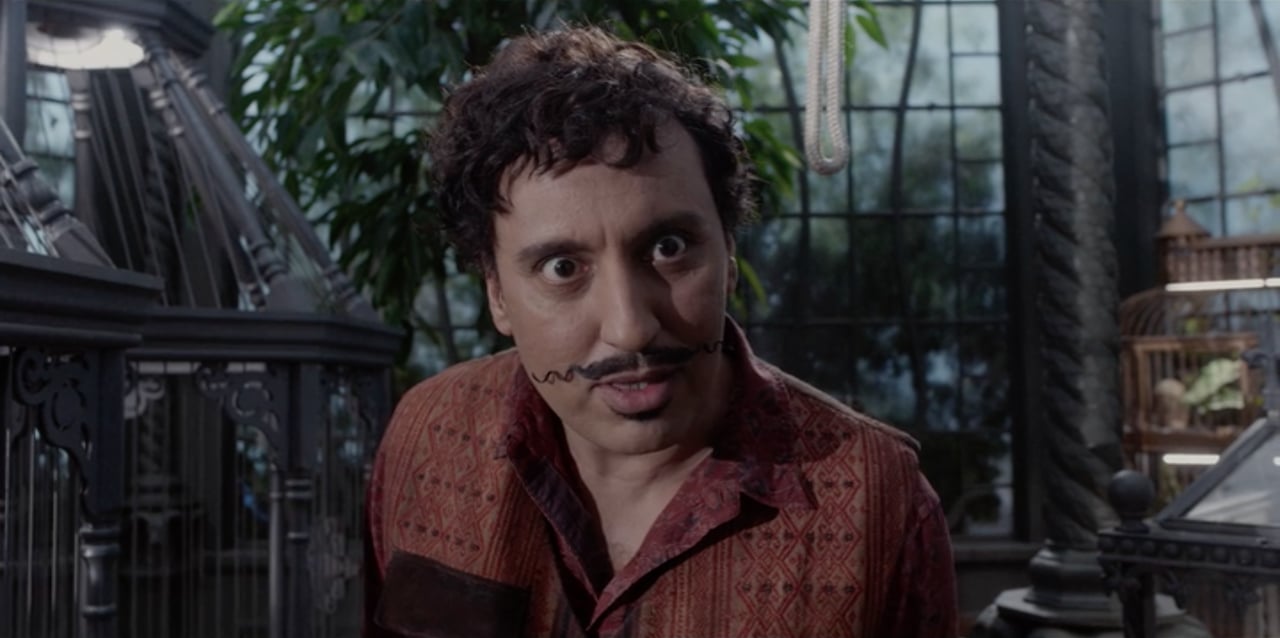
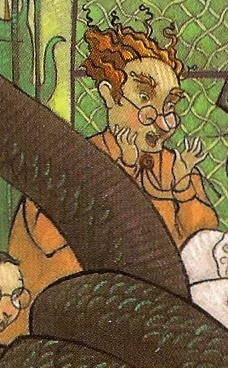
Now, I'm not much of a fan of diversity for diversity's sake, but I realize that it's important. The only problem I had with it was Dr. Montgomery. His description in the book was distinct, and there was a disconnect because he didn't look how I pictured him. However, I'm not all that mad at it because Aasif Mandvi does a fantastic job as Dr. Montgomery Montgomery. 


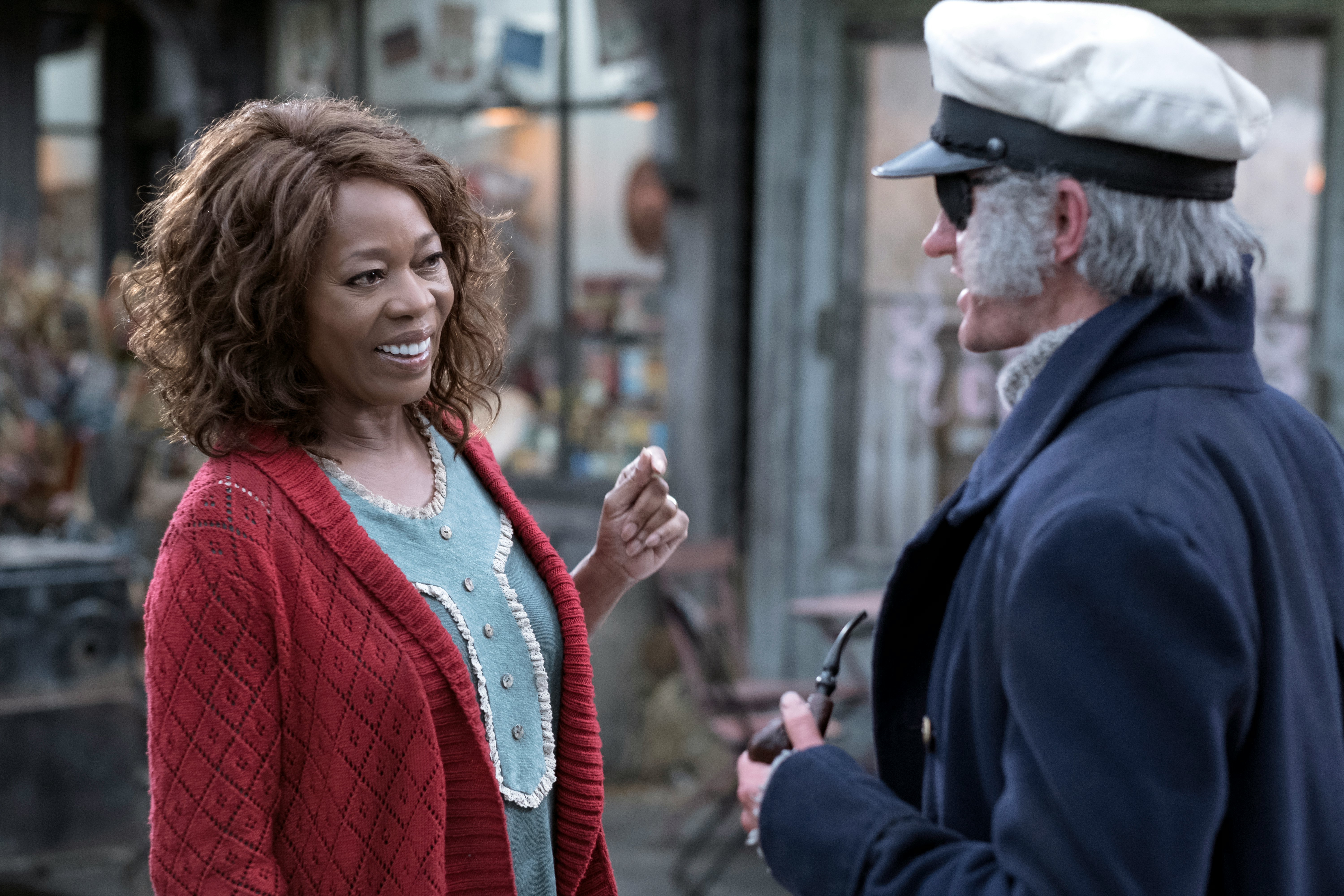
Another instance is Aunt Josephine. While she is never explicity described and there are few illustrations of her, I've found that most people did not picture her as a spry and passionately fearful black woman. However, Alfre Woodard did a fantastic job, and, like I said before I'm not complaining.


4. Accuracy and Even Improvement of the Books

The accuracy of this TV show to the books was impeccable. It had little details that had Lauren and I pausing, and back tracking, and pausing, just to see a little sign in the background, or to read one of the fleeting newspaper articles, or to indentify a symbol in the scenery. Every detail was important, and it was as perfectly utilized in the TV show as it was in the books. 

Sometimes, the script was line-for-line from the books. This just added a charming nostalgia that cannot be replaced, even if they got every single detail right. This made it truly feel like not just a TV show, but that it was a book in visual form, which is really all the fans truly want. 

Somehow, the TV show improved upon the books, which doesn't seem possible. When turning a series of books into a movie or TV show, some things have to change, because the vehicle in which the story is being delivered changes. However, these changes were for the better. 

One of these is adding Lemony Snicket in as an actual character. In the books, he is the nondescript narrator, but by adding him in as a visual character and not just a voice, this adds a sense of grandeur to the story, and makes his later tie in to the Baudelaire's story better set up and integrated into the story. 

Another is the addition of the spyglass. This provides a constant, a mystery to always be solved. It gives more visual, tactile proof that something larger is happening, which is something needed in a visual medium, such as TV. 


~

Overall, it was always a joy to watch one of my favorite childhood series on the silver screen. There's no other way to describe it - it was perfectly nostalgic and enjoyable and as charismatic as the books. Given it's flaws, I'd still watch it again and read the books again and wait eagerly for Season Two. As book-to-screen adaptations go, this is stellar. I give Netflix's A Series of Unfortunate Events an A-. 


Now, the real task is to wait for Season Two. Time to get my brother to watch it!

~The WordShaker