Showing posts with label tv shows. Show all posts

Saturday, August 18, 2018

"Inaccurate Portrayal of Mental Illness" - Debunking the Myth | Olivia J

"An idea that is not dangerous is unworthy of being called an idea at all," -Oscar Wilde

"(in)accurate portrayal of mental illness"

That phrase gets thrown around a hell of a lot these days. 

And I'm sick of people abusing it. 

Phrases like this get thrown around concerning shows like 13 Reasons Why, and basically any other form of art that involves a story. However, it is grossly and inherently problematic because it assumes something extraordinarily harmful about mental illness itself:  that mental illness is homogenous. 

I think that most of us can agree that 13 Reasons Why is not a good show. The writing is poor, the characters are inconsistent, and the depiction of suicide is harmful. 

Now before you all light your torches and call me a hypocrite, let me establish:  there is a wrong way to portray mental illness, but there is not one single way to portray mental illness. 

Let me explain. Portraying mental illness incorrectly involves assigning inaccurate or inconsistent symptoms to a mental illness, perpetuating harmful or incorrect stereotypes and stigma around mental illness, and not portraying mental illness as something that is treatable. Basically, the wrong way of portraying mental illness is spreading inaccurate information. Most other things are up for debate.

The tricky part is that many people - including myself - found 13 Reasons Why as a very harmful and inaccurate portrayal of mental illness (I'm looking at you, producers-entirely-ignoring-the-advice-from-a-psychiatric-board). It idealizes the fallout from suicide, spinning it out to be revenge instead of untreated mental illness. It blames suicide on everyone else instead of Hannah Baker. It never puts a quantifier on mental illness, and paints an utterly hopeless picture of the topics it explores. 

However, I've spoken with many people who have identified with the bullying and social aspects of 13 Reasons Why. And who am I to invalidate their feelings and experiences? Despite that the myrad of reasons why 13 Reasons Why falls flat on its face, bullying can contribute to mental illness, and if 13 Reasons Why resonated with someone - if someone saw themselves in 13 Reasons Why and they felt it was an accurate portrayal of their struggles with bullying and mental illness - then I have no right to tell them any differently. Because guess what?

There's no one single way to have a mental illness. 

From depression, anxiety, and trauma, to schizophrenia, disassociative identity disorder, and eating/substance abuse disorders, everyone experiences mental illness differently. My PTSD doesn't look like your PTSD. My friend's depression doesn't look like my family member's depression. Portrayals and/or content that one person finds harmful or triggering may not bother or affect another. 

To claim that your experience of mental illness is the correct or only experience and that your experience of mental illness ought to be the only one portrayed in media is unbelievably selfish and insensitive to the millions of other people who experience mental illness differently than you.

Truthfully, this is partially a call-out post to myself, because I've claimed that 13 Reasons Why isn't an accurate portrayal of mental illness, because it's not. For me. However, I'm retracting that statement to some degree because I know it resonates with some people, and I don't want to invalidate them. I'm not perfect, and I continue to evolve and grow as an artist, a consumer, and a critic. 

However, next time you're tempted to call a piece of media an 'inaccurate portrayal of mental illness', consider whether it is literally a factually incorrect and harmful portrayal, or whether it just doesn't align with your experiences and therefore you personally can't relate to it. 

Because nine times out of ten, there's someone out there who can relate to it, and they shouldn't be robbed of the experience of being profoundly impacted and deeply understood by storytelling. Nobody should. 

~The WordShaker

Saturday, February 17, 2018

The Devolution of "The End of the F***ing World" | TV Review

"If my doctor told me I had only six minutes to live, I wouldn't brood. I'd type a little faster," -Isaac Asimov

The End of the F***ing World is brilliant. 

It really is. It's dark and subtle and blunt but also deeply heartfelt. I watched this story in one massive, exhilarating breath. 


However - and if you're a regular, then you saw this coming - it has some problems. If you're here looking for all of the things that TEOTFW does right, then you've come to the wrong place. There are hundreds of other reviews that cover the almost insurmountable good aspects of TEOTFW. This blog post is all about the bad.

You've been warned. 


~

The show starts out fantastically. And by fantastic, I mean FAN-F***ING-TASTIC. 

TEOTFW jumps off from the premise that James is a self-diagnosed psychopath and Alyssa is a moody and rebellious teen disillusioned with her family life. Immediately, this intrigued me. It seemed like your typical road trip love story with a dark twist. And to a point, it was. 

James is established as an unfeeling outcast with a dark and ambiguous past. For a while there, there's this strangely wonderful disconnect because you care for him, but you also hate him because he's kind of an awful person. 

Then there's Alyssa. She's tough-as-nails and rude, but also carefree and eccentric. She's the character we identify with the most at the beginning, not just because of characterization or development, but because she shows a full range of emotions, and James is still a bit of a terrible person at this point. 

*Side note: Can we just take a moment and praise the storytelling gods that neither James nor Alyssa were manic pixie dream characters?*

I'd argue that Episodes 1 through 4 are the strongest. They carry a subtle emotional weight, while softening the two hardened characters with an incredible amount of interesting tension. And I think I've narrowed it down as to why the rest of the season falters. 

There's a moment that perfectly verbalizes the problem. James thinks to himself: 


"Having finally murdered a human, I realized something quite important: I was pretty sure I wasn't a psychopath."

After James kills the serial rapist/murderer - and after the aftermath - , the story seems to meander along until they inevitably get caught.  It nearly devolved into a generic teen-love road trip story. 

And it's because that nearly all narrative and character tension disappears. 

The pitch for the story, and what the story hinges on - James being a psychopath and road tripping with this girl to find her father - disappears. Sure, they still try and find her father, but the foundation of the story and what the first four episodes was built upon is torn out from under it. The main concept just falls apart. 

After about Episode 4, James subsequently loses about 75% of his character complexity. Instead of being mostly unfeeling and hell bent on murder, he becomes a shy boy with a tortured past (which everyone has seen before). He loses this complexity because now, James has very little to do other than run from the law. More on that later.

The show also loses its dramatic irony, which is what made the first episodes funny in a skin-crawling kind of way. In turn, it loses it's narrative tension. Back when we believe that James is going to kill - or, at least, attempt to kill - Alyssa, it adds a sense of unease and anxiety to an otherwise strong, heartfelt, and darkly funny teenage 'finding yourself' road trip. And that was extremely engaging, interesting and new in an often contrived but well-meaning genre, and I was disappointed when the whole show unraveled from there. 

Th show's other main problem is it's focus. At the beginning, James is the focus. While Alyssa is his means to an end, she remains a strong and consistent driving force in the story. However, the picture is still painted that James is the protagonist, while Alyssa is one of the two main characters. (Yes, there is a difference. Look it up. Article #1, #2) I digress.

After James' "goal" is reached (killing someone), he ceases being the protagonist, and the mantle moves on to Alyssa, who still needs to find her dad. However, while well executed, her story arc isn't nearly as interesting as James'. 

Ex: "Girl searches out deadbeat dad only to find that he's a deadbeat dad, realizes stuff about life, and falls in love with a boy?" Totally haven't seen that one before. But "teens with emotional baggage embark on a quirky road trip PLUS some psychopathic tendencies and dark humor?" That sounds a hell of a lot more original. 

The story tries to tie it back in, making it James' story with the final moments of the show, but it falls flat since we've spent the last half of the season with Alyssa as the focus. 

TEOTFW seems to be divided into two equal parts. A dark teen comedy-drama with amazing subtlety and a compelling thread of tension to an almost stereotypical teen love story  with the themes of love, deadbeat dads, and quirk. But, like I said, the latter isn't bad, but for a show that starts off so incredibly strong while including the classic elements of the teenage road trip, the last four episodes feel . . . lacking in the dry charm, subtlety, and tension that made the first four episodes so good. 

That all being said, TEOTFW is still fantastic. I still highly recommend it. The characters, direction, dialogue, and emotional and humorous dynamics are all wonderful. I can't stress that enough. Days after finishing this show, the story stuck with me, and I expect it to stick with me for a while. However, it stumbles a bit from dissolving character and narrative tension and focus problems. 

Objective Rating: 8.5/10 would recommend.
Enjoyment Rating: 9/10 would recommend. 

I think I just expected something different. And maybe that's on me, or maybe that's on the show for portraying A, B, and C throughout the first four episodes, but then portraying X, Y, and Z for the rest. 

But I digress. In conclusion: watch The End of the F***ing World so we can fangirl about it but also pick it apart together. Think of it as a bonding experience.  

~The Wordshaker

Saturday, January 27, 2018

How I Review Books | Olivia J

"We read to know we are not alone," -William Nicholson 

Now, this is a strange one, because I feel like, to the moderate reader, rating books is simple: one-through-five stars. However, I review books very differently than other people. I say this because, to me, a 2.5 star book isn't a bad book. Just an average one. 


~

First, I think it's important to understand how I read. 

I read - and watch - VERY critically. I try to be both objective and subjective when I read or watch anything. The objective side of me analyzes the writing style, the character development, the story structure, and the overall effectiveness of these elements. The subjective side of me considers how much I like the story, how much I love the characters, and my overall enjoyment of the work. 

Now, these two things do intersect a tad. I tend to enjoy a book more if it's well written and constructed. I certainly have preferences that effect both my subjective and objective reception of a book. 

~

Onto how I rate books, specifically. On my blog, it's a little different than how I rate books on Amazon/Goodreads. 

On my blog, I use two different rating scales. The first is my 'Objective Rating'. With my Objective Rating, I evaluate the book on technical levels. Does the writing flow, and does it fit within the story and character context? What events and elements add or detract from furthering the story's plot? How are the characters developed, and why is it effective or not? , et cetera. 

Strangely enough, there is a small gray area that contains books that are objectively good, but that I didn't enjoy. For example, I thought Charlotte from Retribution Rails was a well written character, but I just didn't like her all that much. Looking back, I think Frankenstein is a brilliant exploration of the ethics of science, groundbreaking science fiction, and the state of monstrosity, but I absolutely hated my life every time I had to read it. Books, and elements from stories sit in this small gray area, where the said work is technically good, but it just didn't connect with me personally, so I didn't enjoy it. 

Secondly, the other way that I rate books is on my 'Enjoyment Level'. This one's pretty self explanatory. For this category, I consider my personal preferences, the entertainment value, how engaged and invested I am, and of course, how much I enjoy the overall reading experience. 

Some books (and stories) that I think are objectively not very good, but I still enjoyed them include the tv show Riverdale, and the ACOTAR series by Sarah J. Maas. The ACOTAR series is problematic and cluttered and corny, but the first two books sure did hold my interest and provided more than enough smutty entertainment. 

I rate both of these scales on a zero to ten scale (although I've never rated anything a zero before). This influences my overall out-of-ten score, which I frame as "X out of 10 would recommend." I usually omit how I rate the book on Amazon/Goodreads, since that kind of undercuts my previous three ratings in the first place. 


~

In conclusion, when I rate a book 2.5 out of 5 stars, it doesn't mean that I didn't like the book, despite what the rating looks like aesthetically. Truly, it means the book was average. However, I do save 5 star ratings for books that blew me away. 

I hope this helped you better understand how I rate and review books! What's your process for reviewing something? Let me know in the comments of this post or on Instagram @olivia.j.the.wordshaker!

~The WordShaker


Saturday, December 16, 2017

The ONE Flaw in Stranger Things S1 | Review by Olivia J

"I think we ought to read only the kind of books that wound and stab us," -Franz Kafka

I love Stranger Things. 

Yes, you read the title correctly. I do love Stranger Things. 


Follow me on Instagram. I post fun stuff.
However, like most things, it's not perfect, despite what everyone and their mother says. 


For this review, I'm not going to go in depth on why Stranger Things is fantastic. There are hundreds of other reviews for that. Mostly, I'm going to discuss the one flaw that holds it back from greatness. 

(Spoilers, duh.)


Everything else (music, cinematography, atmosphere, etc.) was all really good, but I will mention the major thing that resonated with me.

The Characters

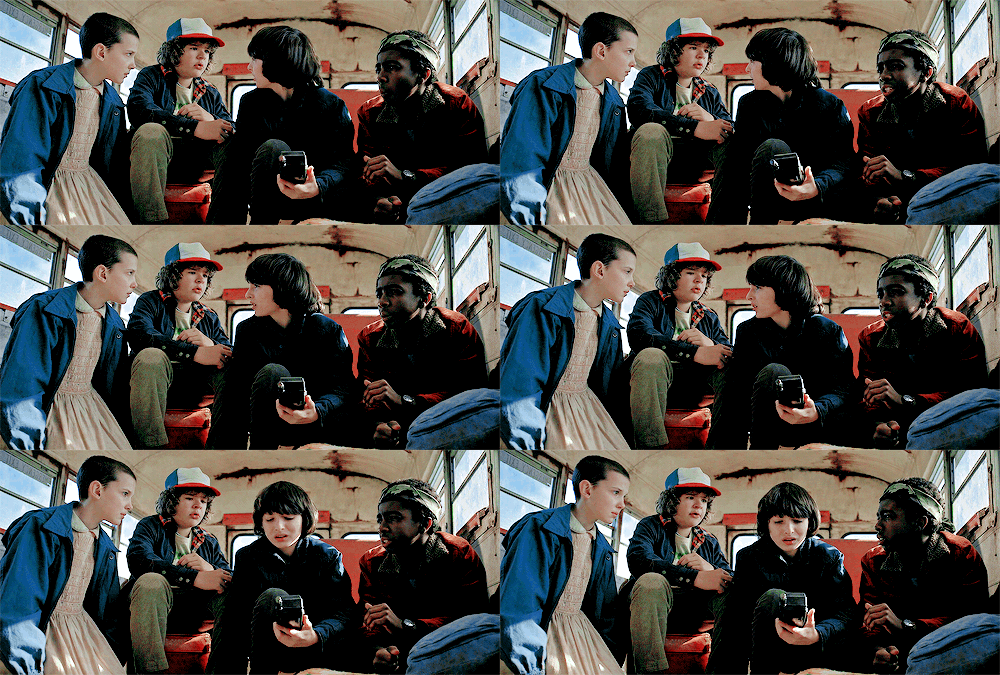
The kids, aside from being great actors, are endearing, funny, and realistic. 


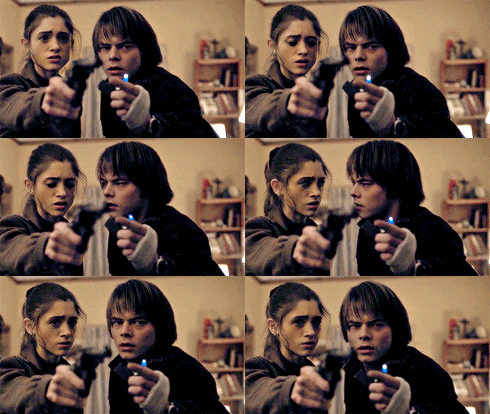
Jonathan is one of those phenomenal characters who is a little bit of an awful person - which, in my opinion, are the best characters. 

I didn't much care for Nancy at the beginning of Season 1, but she really grew on me, and now she's one of my favorites. She's strong and sensitive and unbearably human. 

Also, Jancy is endgame. 


The adults in Stranger Things are competent and compelling and PRESENT. For the most part. 


The characters in Stranger Things are what really sold it for me. Pretty much every character was complex, human, and compelling. If a story has great characters, I'm pretty much down for anything. And for that alone, I love Stranger Things. 


~

And, the moment you've all been waiting for . . . .

The BIG flaw of Stranger Things is . . . . . . 

The Pacing

For a show called Stranger Things, it sure does reveal most of its hand pretty early on. 

I hate to compare it to Lost, but . . . . 

I'm going to compare it to Lost.

So, in Lost, we don't even SEE the Smoke Monster until the end of Season 1, and at that point, it's just snippets. However, the monster is always lurking, giving the other plots throughout the 6 seasons a sense of danger and mystery.

And this is where Stranger Things loses it's footing. There's never that sense of mystery of what all this is. The way the characters figure it out and explain it all kind of makes sense and subsequently makes the remainder of the show seem so much less . . . strange. Sure, there is that thriller/suspense, however, it's undercut by the inclusion of the Upside Down and what the monster actually looks like very early on in the season. 

The show doesn't give its audience time to think over and ponder the mystery. What Lost did so well - and what Stranger Things still has to learn - is finding that sweet spot of revealing just enough to keep the audience guessing, but also not too much that they get bored or can predict what's going to happen. 

Stranger Things would have done well to extend the seasons a bit, and keep some key details under wraps for a longer period of time. 

~

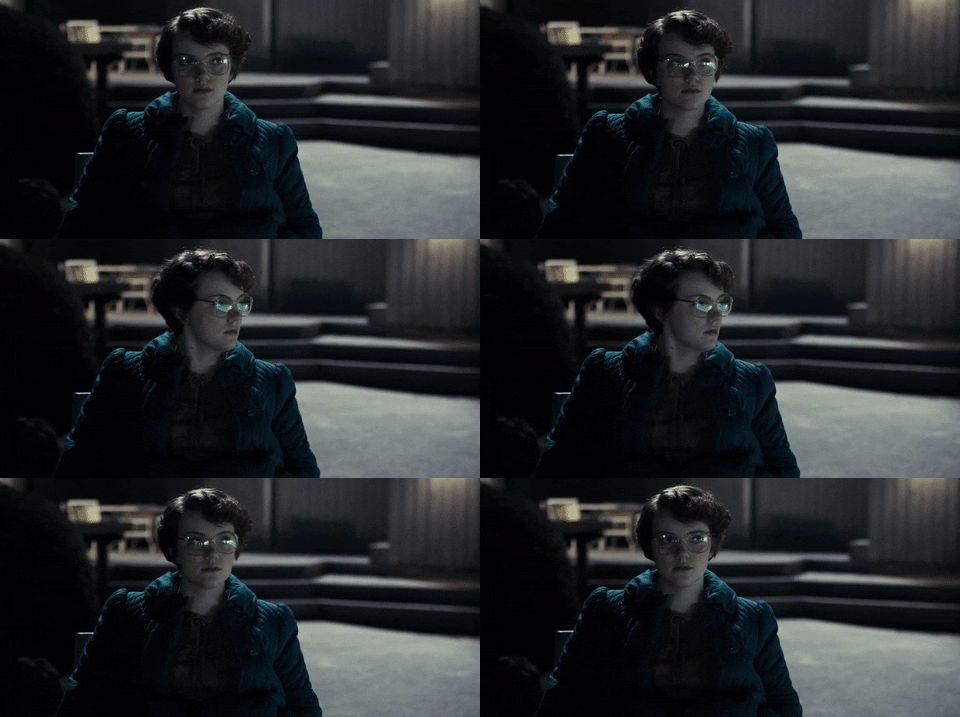
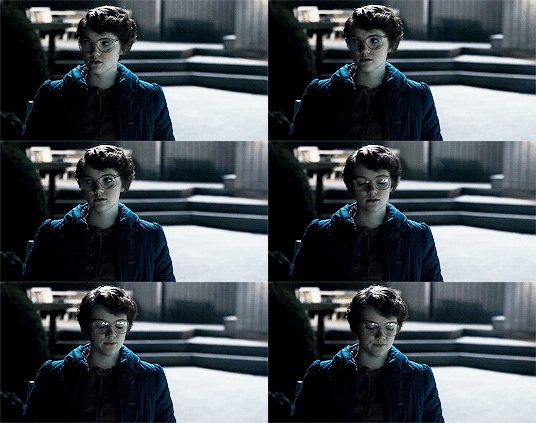
(Also, a little nitpicking: Why does no one else care about Barb? Ahem, she's missing, too.)


I've started Season 2, and so far, it's better than Season 1, but S1 is still fabulously iconic. 

Please don't rip me apart because I didn't find Stranger Things perfect. 

I mean, I'm not sure that you all expected any different from this self-proclaimed critic. 

~The WordShaker

Saturday, February 18, 2017

It's More Fun If They Die at The End | Analysis of The 100's Season 4

"The worst thing you write is better than the best thing you did not write," -Ellen Jackson


PSA: Sorry there was no blog post last week. Life caught up with me, and I ended up having NO time. Hopefully that won't happen again. On to this week's post!
~

It's more fun if they die at the end. 


While this isn't always the case, in many post-apocalyptic or science fiction stories, it should be the case, especially when the situation is hopeless. 


Where shows and books write themselves into a corner, is that they set up this hopeless situation, creating this plotline that drives the story. However, what all too often happens is that the infamous plot device deus ex machina quite literally pops up. 


A deus ex machina is where a seemingly unsolvable problem is suddenly abruptly resolved by the inspired and unexpected intervention of a new event. Thanks, Wikipedia. 


The way that Season 4 of the 100 is progressing is that the radiation is exponentially growing, and will wipe out 99% of life on earth, as claimed by the show. The main plot involves them trying to find ways to either stop the radiation or protect everyone from it as it ravages the earth. Our favorite flawed leaders, Clarke and Bellamy, are trying to save the day, along with a neurotic Raven. 


In this past week's episode, there is almost a hope of having another bunker, built by a religious zealot. My initial thoughts during the episode consisted of "oh no, this place is going to be habitable, and then the rest of the season is just going to be them fixing it up and making it usable."


What the episode beautifully pulls off is convincing the audience that this place would be intact and able to support the earth's populous. When this doesn't end up working out for our fatal heroes, I felt almost a relief. 


Why?  Don't I want everything to work out peachy and for everyone to survive?


No, not in this case. Because if another deus ex machina comes in and saves everyone, then there will be no point, the cycle of surviving and killing that The 100 has found itself in will only perpetuate. 


My projection is that this season will be The 100's last. I almost want it to be it's last season, because it will create a beautiful story arc with my predictions. 


1a. Clarke and Bellamy are unable to find another place except the Ark to hold 100 people, almost poetically. 


1b. 100 people, hopefully not our main characters, hole up in the Ark and survive the nuclear meltdowns. Our main characters die happily, having fulfilled their mission and resolved the conflict, and the human race lives on. 


2a. The Ark is somehow damaged beyond the repair of fixing in time. There is no place to hide. 


2b. 99% of the human population dies. However, our characters accept their death and live their last, sick days to the fullest. Or, they put themselves out of their misery via group suicide. 


I want my beloved characters to die because it will wrap up the story. Truly, I see almost no way out of this situation. The only other avenue I could see is if Season 5 would cover the straggling survivors on the Ark. 


However, the ending of the series would be much more impactful if it ended here, and in the two scenarios I provided above. 


It would be more impactful because if everyone or our beloved characters died, then it would give the message that you can't just live life by surviving, and sometimes dying can be more fulfilling than living. If everyone died, it would be poetic justice. The Arkadians sent down the 100 to die, they didn't die, but later, they ended up dying from radiation fallout, having learned all they could on the ground. It would be a fulfilling and timely death for all of our original 100. 


Compare this to the movie Passengers, starring Christ Pratt and Jennifer Lawrence. They are faced with a spaceship that is breaking down, and they have woken up about eighty years too early to arrive at their destination. After fixing the ship, and, of course, realizing they love each other, they accept their fate, which is that they won't be able to reenter cryogenic sleep. So, Pratt's and Lawrence's characters 'bloom where they're planted' so to speak, and live out the rest of their lives, alone on the ship. This is the impactful, deep, and emotional ending I have envisioned for this series. 


I suppose I wouldn't be mad if Season 5 continued on with some of our main characters inside of the ark riding out the radiation, but then, that would definitely have to be the end, with the remaining survivors barely scraping by to rebuild civilization. However, Jasper, everyone's favorite drug addict alongside Charlie Pace, has been the ringleader of what I want to happen. 


The characters learn to live, not just to survive, accept their inevitable death, and find peace within themselves. 


A hesitant watcher because Jason Rothenberg has hurt me too much already,


~The WordShaker

Saturday, October 1, 2016

The Unappreciated Awesomeness of John Murphy | The 100


"Screw this, I'm going for it," -any successful writer ever

After a hard, stressful day at school, sometimes I just need to watch my new favorite TV show: The 100.

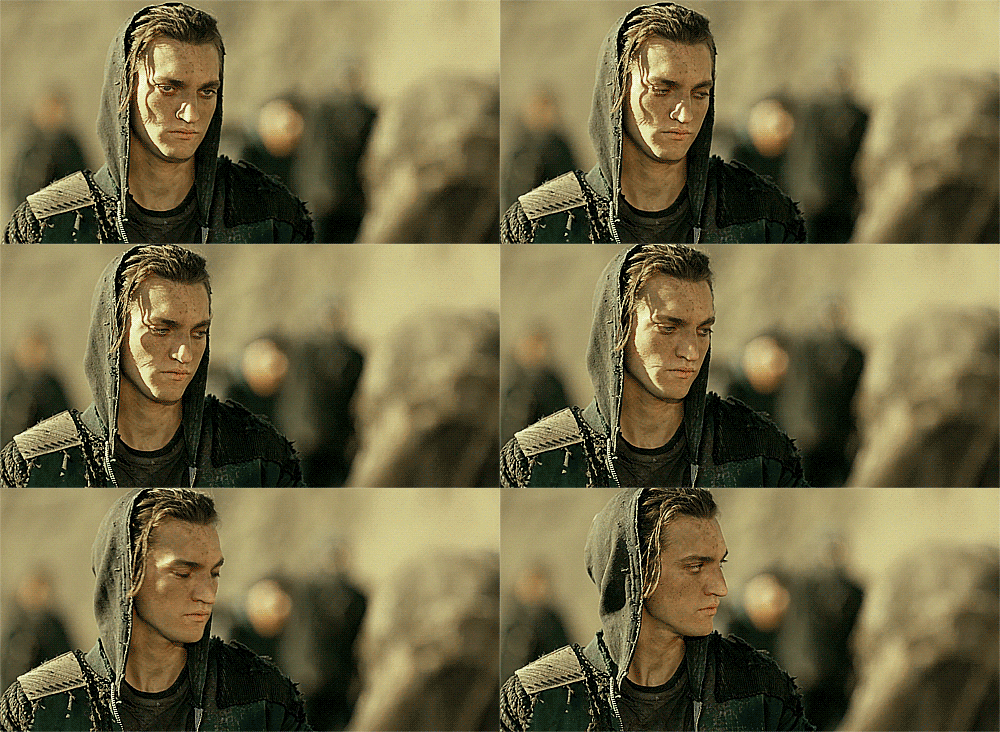
And this week's ramble is about the infamous John Murphy, A.K.A., the resident asshole, who I actually very much enjoy. 

When the show started, I hated him. I thought he was just awful and that's all there was too it. However, he was fun to watch because he was so cynically sarcastic and created conflict. 


But then, I grew to love to hate Murphy. I loved seeing the terrible shit he was going to do next because he was aggressively unpredictable, which, I hate to say, was super entertaining. It made for great tension.  


But then, around the beginning of Season 2, something crazy happened. I was so angry that he shot Raven, but then, in the dropship, he told her his life story, and, all of a sudden, it clicked. And then, soon, he grew into himself, I think. He opened up, and he let that go. 


Murphy's conscience began to show more as him and Jaha began traveling to the City of Light. As soon as he truly saw all of the awful things that Earth - as well as the people on it - had in store, they began to have the opposite effect on him. While other times, it hardened him, it became too much, and he cracked. Murphy changed. 


But what I love so much about this is that he kept his gruff and aggressive demeanor. And, damn it, sometimes he's so funny. His dry humor is perfectly placed, and he knows just what to say at the right time to say it with his beady eyes and pursed lips and scowl.

And so begins Season Three. 

The season starts off with Murphy on the edge of suicide, and his descent into this is powerful and gripping, just another show of Richard Harmon's amazing acting ability. 


He is strong and resilient and conscious in his opposition of Jaha and ALIE. While aspects of Murphy change, such as his outlook on life and his demeanor, the sad, manipulative, selfish, and raunchy core of Murphy never changes. Which is actually pretty great. 


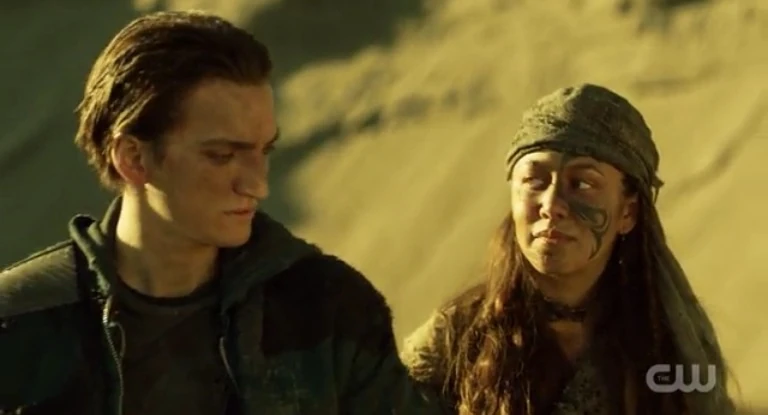
Murphy and Emori together are fantastic. Not only is Emori equally badass and complex, their banter is entertaining, and their chemistry is on fire. 


On to his rape - and yes, Ontari raped him. Right after Titus beat and tortured him. Subtle in it's delivery, it poignantly shows the nuances and coercion of rape. It's just another layer in the deeply broken, sarcastic, and relatable John Murphy. 


The season ends with Murphy as the best part of it. He fights for Emori until the bitter end, and it's utterly fantastic. His greyness as a character is what makes him so dynamic, and, ultimately, so relatable and utterly loveable. 


Overall, I love to hate Murphy, but I also hate to love him. 

He's awesome, cunning, brave, cynical, funny, reckless, and badass. And also just an ass. 

But I absolutely love it. 


~

I've finally concluded that John Murphy is the 'Sawyer' of this series. 

If you have no idea what I just referenced, what the hell are you doing with your life?

~The WordShaker

Saturday, May 21, 2016

The Importance of Studying 'Your' Genre

"The thing about creativity is, people are going to laugh at it," -Twyla Tharp

In my bookshelf, I have an entire section dedicated to what I call 'my genre', which is along the blurry lines of survival/disaster/personal growth and change/romance. Seriously.  It's full of media, from my favorite movies (127 Hours, Titanic)  favorite TV shows (LOST),  favorite books (The Girl Who Loved Tom Gordon, The Book Thief), testimonials and true stories, along with reference journals and informational books all concerning my genre.

What makes it 'my genre' is that I enjoy the media in it so much and most of my novel writing falls in this genre. For a friend that I have, she loves the fantasy genre, and she pursues and consumes all the media she can about the sub-genres of fantasy.

However, what makes studying your genre so important is that you can know what works and what doesn't.  You can learn from the masters - or, at least, the people who are out there and producing publishable work. If you seek the media in your genre with a learning heart and a critical eye, you can then apply this to your work and see the flaws and strengths.

Enjoy watching movies and reading books, my writers!

~The WordShaker